
As power grid scale continues expanding, smart hubtechnology is becoming key to substation intelligent transformation. Traditional manual inspection suffers from low efficiency and high risks. Moreover, the maturity of drone inspection technology now makes fully automated operations a reality. Yiyufei smart hub bridges the gap between manual labor and intelligent automation.
The Challenge of Manual Inspection
Taking a 220kV substation as an examAs power grid scale continues expanding, smart hub technology is becoming key to substation intelligent transformation. Traditional manual inspection suffers from low efficiency and high risks. Moreover, the maturity of drone inspection technology now makes fully automated operations a reality. Yiyufei smart hub bridges the gap between manual labor and intelligent automation.
The Challenge of Manual Inspection
Taking a 220kV substation as an example, one complete indoor inspection requires two workers. Checking critical data like relay settings and parameter values takes approximately 5 hours.
Blind Spots and Safety Risks
Substations feature dense equipment and numerous high-voltage areas. Workers find it difficult to access transformer tops. Furthermore, architectural connection points are in elevated zones, creating obvious visual blind spots. These areas often go unchecked for extended periods.
Data Delays and Missed Warnings
Manual inspection data relies primarily on paper records. Consequently, substantial time is needed later for organization, analysis, and archiving. Complete reports require 48 hours to generate. Therefore, this approach cannot detect status changes promptly, severely limiting predictive maintenance capabilities.
How Smart Hub Achieves Fully Automated Inspection
One-Click Command and Auto Deployment
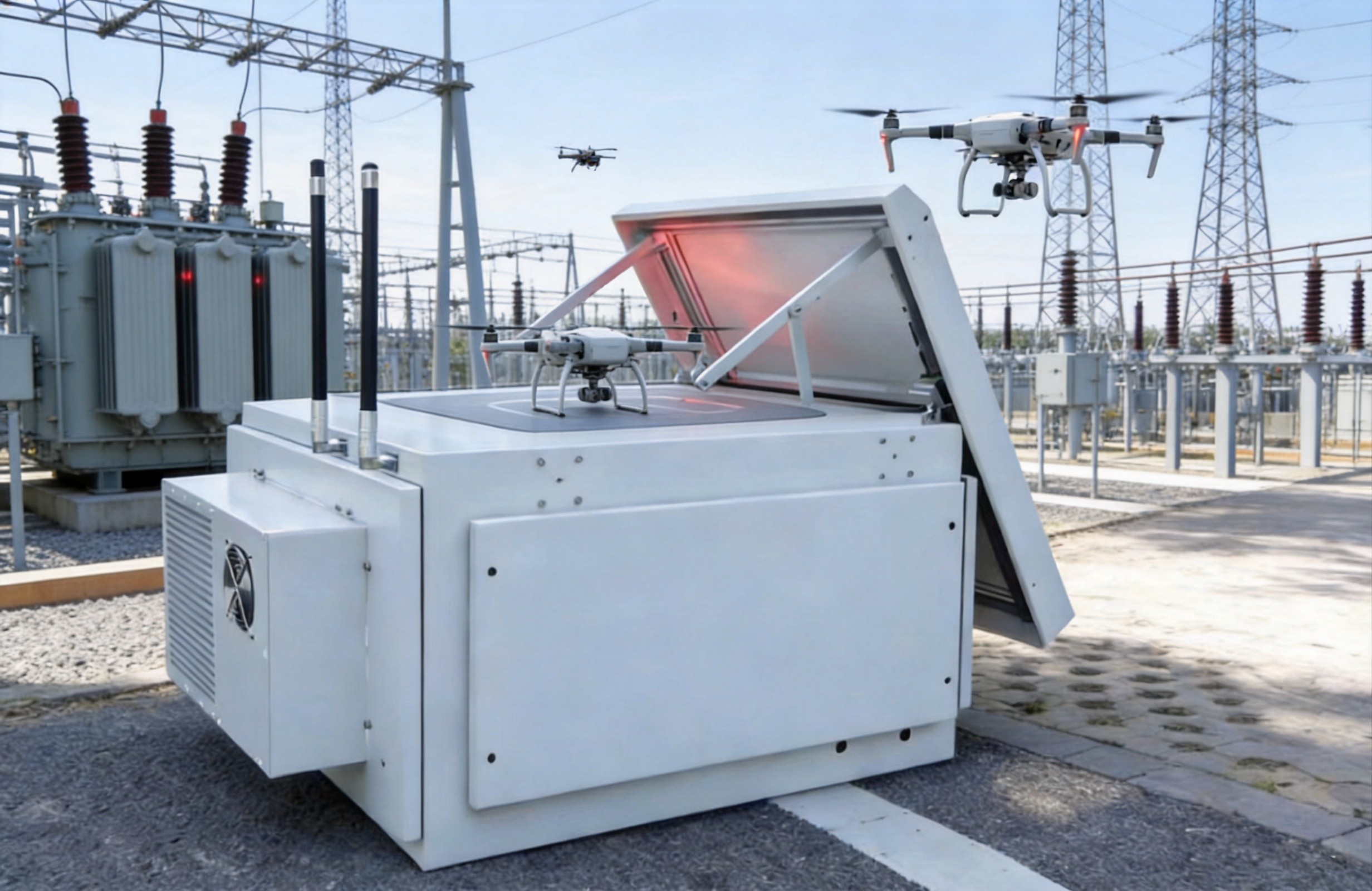
Smart hub serves as core infrastructure for smart inspection. Compared with traditional methods, it enables transformation from manual to autonomous machine operations. Operators simply issue commands with one click from the backend. As a result, the deployed smart hub activates automatically.
Preset Routes and Full Automation
During inspection, drones follow preset flight routes. They photograph transformer oil levels. Additionally, they capture GIS equipment gas pressure readings. They also record critical components like relay protection devices. The design of Yiyufei smart hub achieves fully automated takeoff, inspection, and landing. Consequently, recovery, charging, and data transmission all proceed without human intervention.
All-Weather Readiness and Rapid Response
Smart hub systems include automatic charging modules, weather monitoring equipment, and operation control systems. These features provide all-weather environmental adaptability. Furthermore, response time has shortened from several hours to within 30 minutes, dramatically improving operational efficiency. This drone inspection solution reduces risks and dependency on operators.
How AI Recognition Makes Defects Impossible to Hide
Automatic Defect Detection
Drones collect high-definition images and infrared thermal imaging data. AI algorithms automatically identify and diagnose issues. For example, the system precisely captures subtle abnormalities like corrosion, loose bolts, insulation damage, and equipment overheating.
Standardized Reporting
After identification completes, the system automatically generates standardized inspection reports. Reports include equipment names, status descriptions, anomaly alerts, and on-site images. Furthermore, information remains complete and easy to review.
Real-World Case: Hezhou Substation
CSG EHV WuZhou Bureau offers a strong example. After introducing drone inspection systems at their 500kV Hezhou Substation, inspection takes only 2.5 hours. Specifically, the system covers 726 meters. It inspects over 20,000 equipment points. Work efficiency improves approximately 10 times compared to manual methods.
Proven Reliability Metrics
Smart patrol task performance shows excellent results across three core metrics. Task dispatch success rate exceeds 98%. Execution completion rate exceeds 98%. Additionally, recognition accuracy rate exceeds 98%. These figures fully demonstrate the reliability of drone inspection.
Scaled Deployment in Hubei
Additionally, State Grid Hubei Electric Power has built 799 substations province-wide with smart patrol capabilities. They have executed 46,400 smart patrol tasks cumulatively, replacing 11,911 manual patrol sessions. Moreover, the company developed "E-Dian Hui Tu" software for 3D modeling and route planning. After adopting the innovative "one point multiple shots" intelligent shooting mode, overall inspection efficiency improved approximately 30%.
Outlook for Substation Smart Inspection
From Human Patrol to Intelligent Judgment
The combination of smart hub and AI technology is reshaping substation inspection models. The transition from human patrol-dominated to machine patrol with intelligent judgment dramatically improves inspection efficiency. Ultimately, Yiyufei smart hub solutions ensure that high-altitude blind spot hazards have nowhere to hide.
The Road Ahead
Scaled deployment of fixed smart hub systems is expanding rapidly. Moreover, defect recognition algorithms continue to improve. Consequently, substation smart inspection is accelerating toward unmanned operations. Drone inspection provides solid technical support for secure power grid operation. In summary, the future of power inspection lies in intelligent automation.