
As urbanization accelerates, urban distribution networks continue to expand rapidly. Distribution lines serve as the critical "last mile" connecting substations to end users. Their operational status directly impacts power supply reliability. However, traditional manual inspection methods face significant challenges including low efficiency and limited coverage. The grid-based deployment of a drone hub system is now transforming urban distribution line inspection.
Core Challenges in Urban Distribution Line Inspection
Urban distribution networks feature numerous pole-mounted equipment with complex operating environments. For instance, in the Lishui Economic Development Zone, overhead distribution lines account for approximately 56.68% of total length. Additionally, some areas have steep mountain roads, dense forests, inconvenient transportation. In Chengdu's Qingbaijiang District, distribution lines span diverse complex terrain. Consequently, relying on manual inspection results in slow speeds, low efficiency, considerable safety hazards.
The automated drone platform has gained widespread application recently. However, challenges such as manual launch and recovery remain prominent. Distribution line inspection requires smarter and more efficient solutions.
Principles of Grid-Based Drone hub Deployment
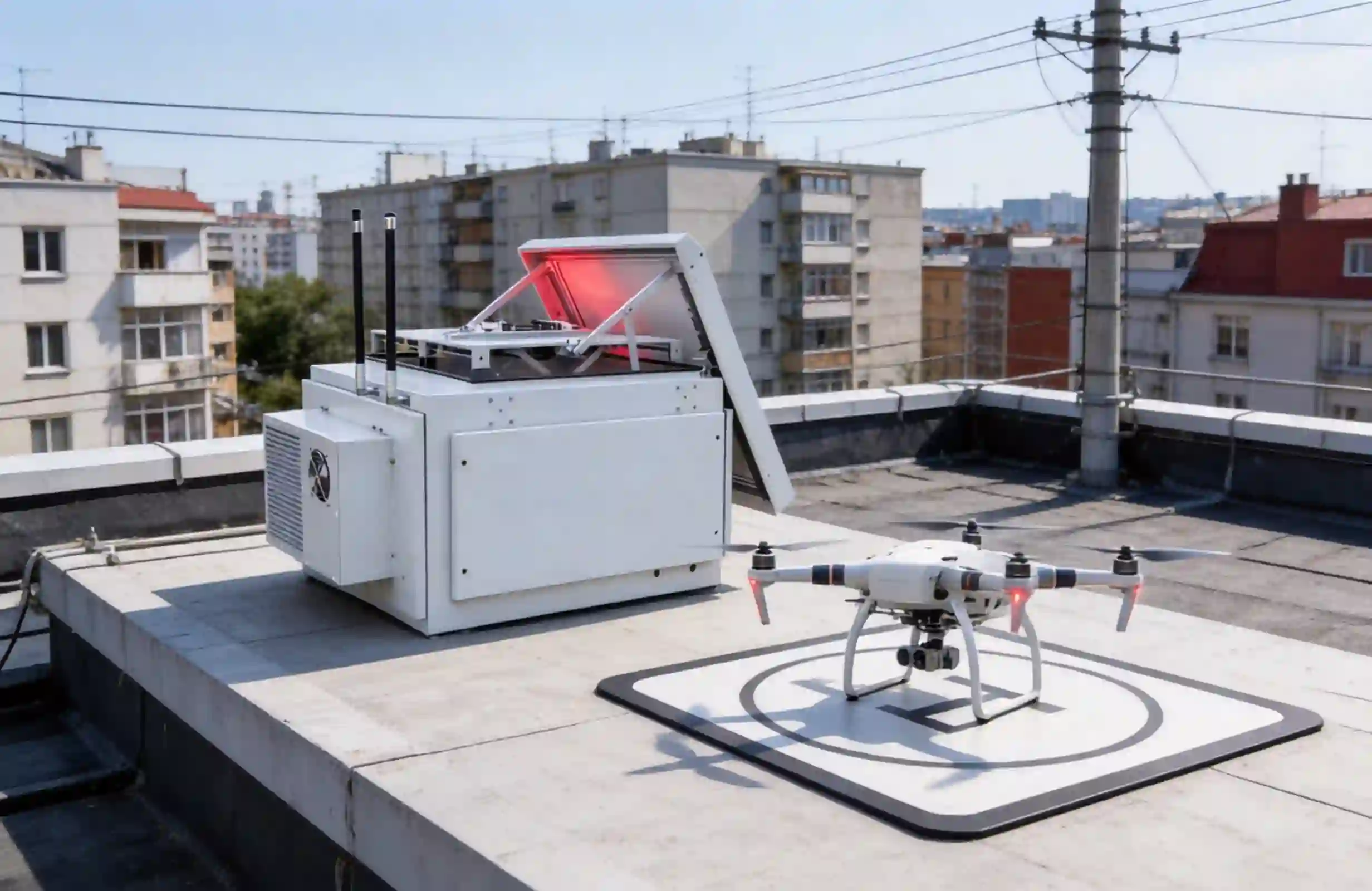
A drone hub serves as the intelligent home for aerial inspection platforms. This automated station integrates automatic takeoff, rapid charging, real-time data transmission. Grid-based drone inspection deployment uses a 5-kilometer operational radius per grid unit for precise coverage.
Technicians analyze distribution network line distribution, routing using GIS systems. Subsequently, they divide inspection grids, plan station locations using intelligent route splitting. Operators connect stations to platforms via secure network integration. Deployment requires ground fixation, power connection, network access, quick configuration via remote controller.
The State Grid Nanchong Power Supply Company follows the principle of "scientific placement, precise coverage." They deployed 32 fixed Yiyufei drone hub units across Yingshan and Yunlong areas. This established a "one airfield, one grid" three-dimensional inspection system.
Practical Results of Drone Inspection
After deploying automated stations in distribution networks, drone inspection efficiency improved significantly. In the Lishui Economic Development Zone, five automated stations provide grid coverage for 74 lines totaling 299.13 kilometers. The average inspection time per line is approximately 3 hours. This represents a more than 100% improvement compared to autonomous inspection. Moreover, it represents over 1000% improvement compared to traditional manual methods, with defect detection rates increasing by more than 200%.
Drone inspection results show significant efficiency gains. The Guizhou Guian Power Supply Bureau deployed seven Yiyufei drone hub units at 35kV substations. These autonomous stations can independently inspect 51 distribution lines with a total length of 214 kilometers. The system completed 189 kilometers of line inspection. It identified 1,149 tree obstacles, 341 insulator defects, 76 bird nests. Defect detection rates improved fivefold compared to manual inspection. Therefore, traditional manual inspection could only complete 8 kilometers per day. However, continuous all-day drone inspection can now cover 70 kilometers daily, with overall efficiency improvement exceeding 700%.
From Human-Machine Collaboration to Machine Replacing Labor
The autonomous drone platform enables fully automated distribution line drone inspection. Maintenance personnel remotely issue inspection tasks from the backend. Drones autonomously complete all steps: flying out of the station, line inspection, return landing, self-charging, data upload. This achieves 24-hour unmanned operation.
During nighttime, drone inspection switches to infrared temperature measurement mode. Thus, this detects heating hazards at line connection points. The system makes real-time weather assessments. When encountering adverse weather such as rain, it controls drone return. Equipment is effectively protected. AI image recognition technology enables defect identification accuracy exceeding 95% for tree obstacles, insulator damage, bird nests.
Multi-Disciplinary Collaborative Grid Inspection Model
Grid-based automated station deployment breaks through traditional professional barriers. The Kunming Power Supply Bureau pioneered Yunnan Power Grid's first drone grid-based joint inspection demonstration zone in Dongchuan, Luquan, Anning areas. Specifically, they constructed an integrated joint inspection system for transmission, transformation, distribution operations.
Four drones simultaneously receive mission signals for drone inspection tasks. They depart from substation-based automated stations, pole-mounted units, village rooftop units, mobile units. Each drone performs its designated function. Furthermore, the joint inspection mechanism enables an integrated platform for unified task issuance, specialized data application. This creates a collaborative effect greater than individual efforts.
Inspection time decreased by 49% compared to traditional methods. Defect detection rates improved by 7.1%. Meanwhile, hazard detection rates increased by 46%. Edge equipment overlap between adjacent grids exceeds 20%. Consequently, a mutual support mechanism is established. When a single grid's automated station experiences failure, adjacent grids immediately take over tasks.
Prospects for Large-Scale Drone Inspection Application
Grid-based drone inspection for distribution line inspection is accelerating across the nation. The Chengdu Qingbaijiang Power Supply Company plans to deploy 10 automated stations throughout the district. These units will fully cover transmission, transformation, distribution lines. In addition, China Southern Power Grid has completed deployment of 28 automated stations. They initially planned over 100 autonomous inspection routes covering approximately 100 square kilometers. These include 4 island substations, 13 transmission lines, 61 distribution lines.
An automated drone station functions like an airport for civil aircraft. It serves as the home providing charging, shelter for drones. Moreover, it acts as the brain assigning tasks, transmitting data. The grid-based model improves drone utilization rates. One drone is shared by multiple professions. One flight serves multiple missions. Consequently, drone configuration within grids decreased by 30%. Manual labor hours were reduced by 60%.
Automated station deployment for distribution networks is driving the inspection model from human-machine collaboration toward machine replacing labor. Ultimately, this transformation is injecting new momentum into modern smart distribution network development.
If you are interested in drone hub, please visit https://droneinspectioncn.com/contact/.